SITREP 1/30/26: Putin Flatters Trump With Kiev-Energy Ceasefire
After various rumors following Trump’s announcement that the Kremlin had agreed to an energy ceasefire with Ukraine, Putin spokesman Peskov finally confirmed the news this morning:
Russia has agreed to partially suspend long-range strikes on Ukrainian targets at the request of US President Donald Trump, Kremlin spokesman Dmitry Peskov has confirmed.
The weeklong moratorium is to last until February 1 and is meant to “create favorable conditions for negotiations,” Peskov told journalists on Friday. He declined to offer additional details about the arrangement, including whether Kiev made any commitments for reciprocity.
Zelensky had previously said he would hold to the truce if Russia does, though some OSINT analysts had already noted that Ukrainian drone strikes on Russia had disappeared in the past day or two, while Russia had only been launching a few minor Geran attacks, presumably at non-energy-related infrastructure for several days.
But what’s interesting is Peskov said that the “week long” truce would end on February 1st, which appears to mean that the ceasefire had already been in effect all week, which would explain the above:
Further note that this appears only to apply to Kiev, which is still suffering badly from the attacks.
On the other hand, there may be some confusion because the Ukrainian side is attempting to push the ceasefire until February 8th—either an additional week, or February 1st being the beginning of the ceasefire.
On Sunday, February 1, at a new round of negotiations in Abu Dhabi, the US plans to formally confirm a week-long pause in attacks on Ukrainian energy infrastructure.
The Ukrainians have asked for a delay until February 8, when the temperature in Kyiv will reach +5°C. After that, warming will begin.
The “pause” is purely psychological. In terms of restoring anything, there are still months of work ahead. The only thing that is currently working, and the main topic of discussion, is the Kyiv TPP-6. A week ago, they launched one of six boilers there, and now they are starting up the second one.
The heat loop from it is already being distributed through Kyiv’s main networks.
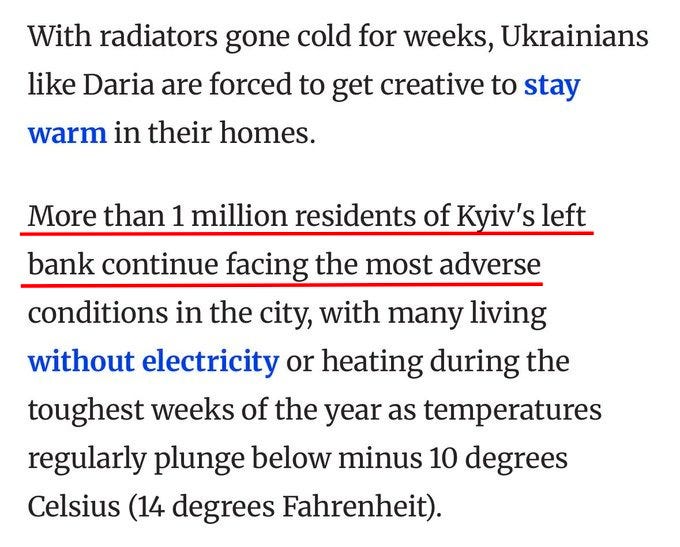
In Kyiv, the collapse is still ongoing, with power grids being disrupted and entire neighborhoods shutting down.
Kiev Independent reports that over one million residents still have “adverse conditions” including no power:
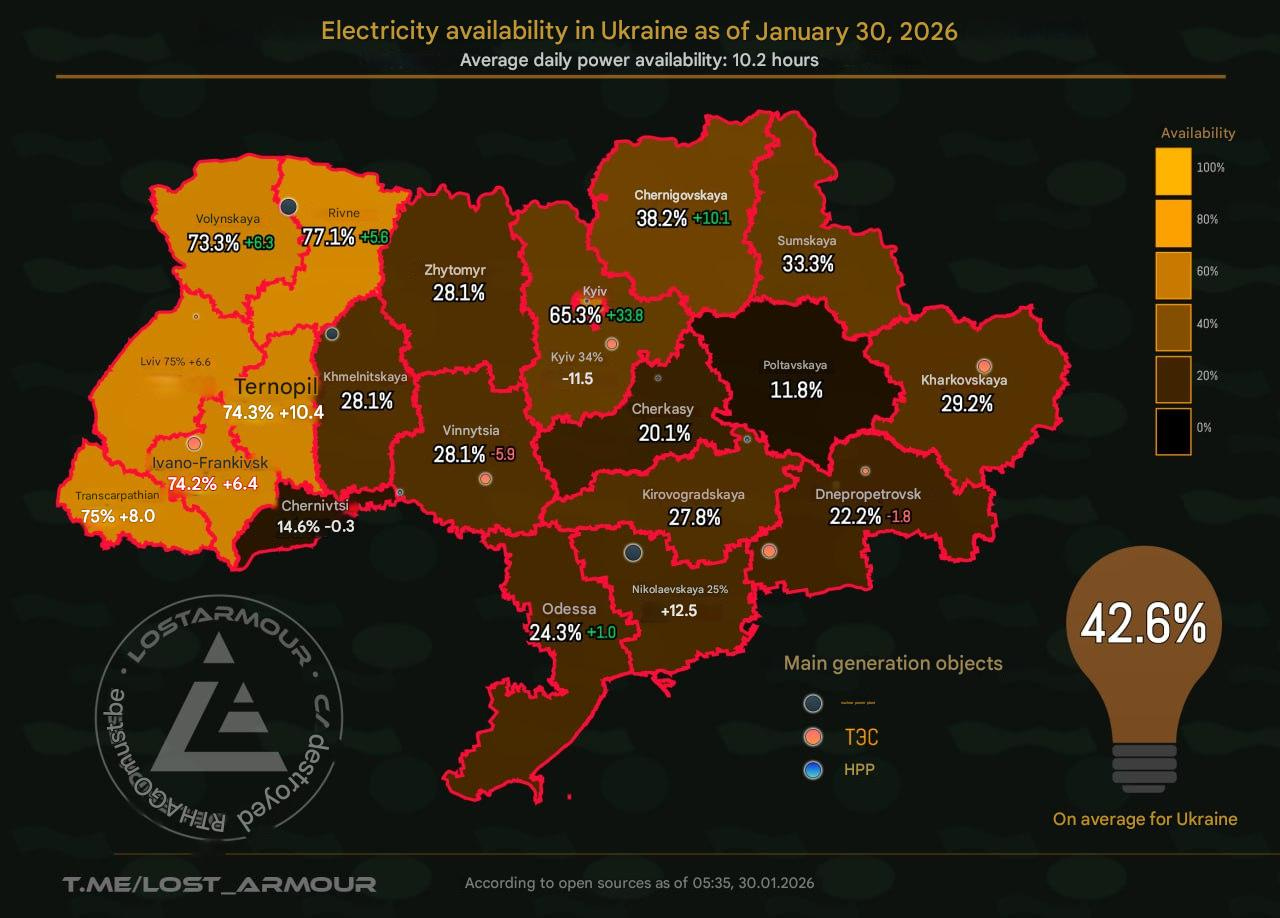
While Ukraine’s main power corp DTEK writes about major Russian strikes to Odessa’s grid just a couple days ago:

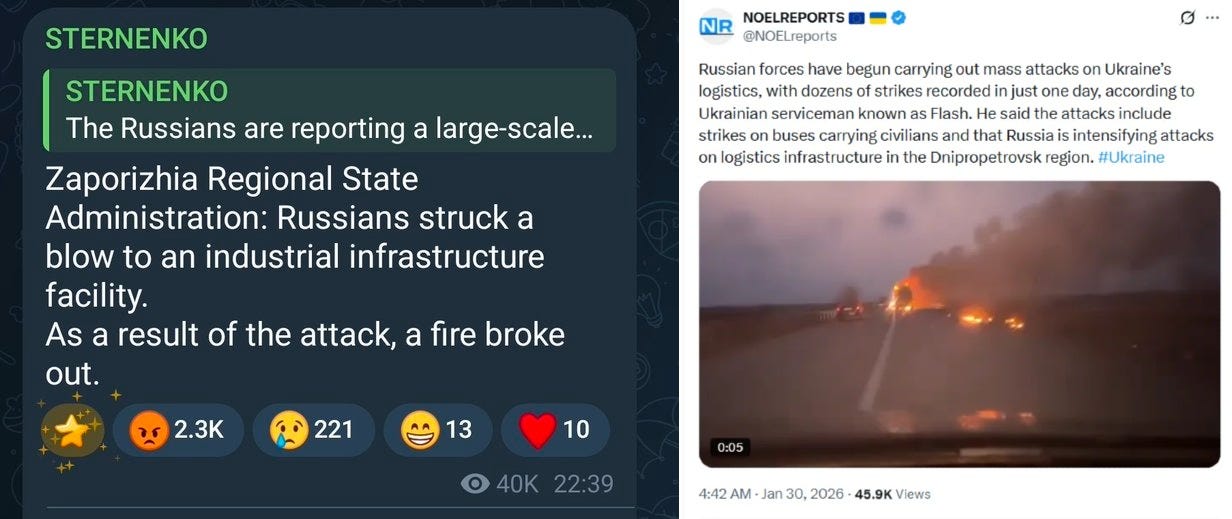
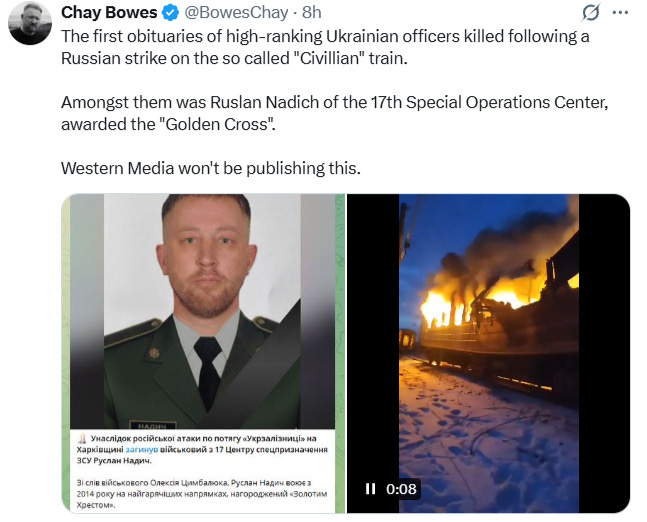
Others report a large-scale uptick in Russian strikes on Ukrainian logistics all over the country, which included a “civilian train” that happened to be carrying military members on board:
As per usual, many on the pro-Russian side will lose their heads over this apparent ceasefire. But it can be easily dismissed for a variety of practical factors: firstly, it’s only a week and only for Kiev—major Russian strikes on Kiev specifically are usually spaced out anyway, and a week is barely longer than the typical amount of time it takes to prepare for a new attack.
Secondly, it’s a gesture that accomplishes a lot by making what amounts to a tiny concession. A week won’t do anything for Ukraine, but it allows Putin to continue gaining favor for Trump—allowing Trump himself to “sell” Russia as the good guys more effectively, with Zelensky as the intolerable and disagreeable agitator.
A week doesn’t really buy time to do much as the type of damage recently witnessed at Kiev’s plants is essentially not repairable at all, to wit:
Lastly, beyond the mere political posturing, there is the actual genuinely real humanitarian concern. Does Russia really want to freeze Kievan civilians in what is said to be coming -30°C temperatures?
One of the biggest secret reasons for the desperate ceasefire, however, appears to be Ukraine’s urgent situation regarding air defense interceptor missiles. Zelensky had just castigated “European partners” for not providing missiles, which allows Russian strikes to now come in unhindered as we had suspected:
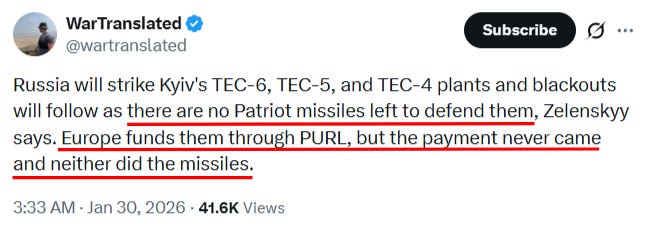
Note in particular the part about the PURL (Prioritized Ukraine Requirements List), which I had debunked before as a scam meant to give the impression of European “solidarity”. Here we see just how “effective” it has been.
A last interesting take from the War Chronicle military analysis channel:
According to preliminary estimates, if the attacks on Kyiv and the region’s power grids continue, the consumption of diesel fuel in the Ukrainian capital could reach 300 to 900 tons per day. This amount will be needed only for the operation of emergency services and industrial generators at production and utility facilities.
If the power supply problems persist, the purchase of diesel fuel on an industrial scale in Kyiv alone over a year could cost 200–500 million dollars.
However, this problem is scalable. There are about 100,000 boiler houses of various sizes in Ukraine: from district to school and hospital/industrial ones.
It is almost impossible to fully power them with diesel generators, but those that can still be connected will also require a large amount of fuel.
A power grid collapse on such a scale is already forcing Kyiv to redistribute some fuel from the front to civilian facilities. The connection here is direct: the more intense and dense the attacks on the energy sector are, the greater the scale of fuel redistribution required for civilian facilities.
So far, the overall availability of electricity has dropped from 43% to 32.7%. This is already considered a threshold value for the degradation of critical networks.
However, a severe energy crisis will be reached when this share drops below 30%, and ideally to less than 25%. When this last figure is reached, the city’s sewage and other purification systems will not be able to operate on generators continuously and will require periodic long-term shutdowns. Interestingly, during the energy crisis in the Gaza Strip, a drop in power supply below 10% led to the complete shutdown of 70% of all critical facilities that could not operate on generators for any length of time. Given the electricity needs for Kyiv, the situation could be even worse, as generators in any case are a backup power source, not the main one. In a sense, the figure of 32.7% availability of the power grid is the last mark before a potential exodus from the cities due to the impossibility of maintaining a normal life.
However, the maximum effect can be achieved under two conditions: the continuation of attacks on power grids in major cities with a parallel transition to the isolation mode of Ukrainian nuclear power plants and their transformation into energy islands, cut off from the general network. Russia is still trying to avoid the latter.
Let’s switch over to the frontline. We haven’t covered it in a while because, quite frankly, the Russian side has continued to be “on vacation” since Christmas time, moving very little since then. However, recently they did begin some activity again, though still nothing like the steamroller of last year’s fourth quarter.
Western publications are now even mocking Russia as having the slowest advance in hte history of warfare:

They’ve even drew up these nifty charts:
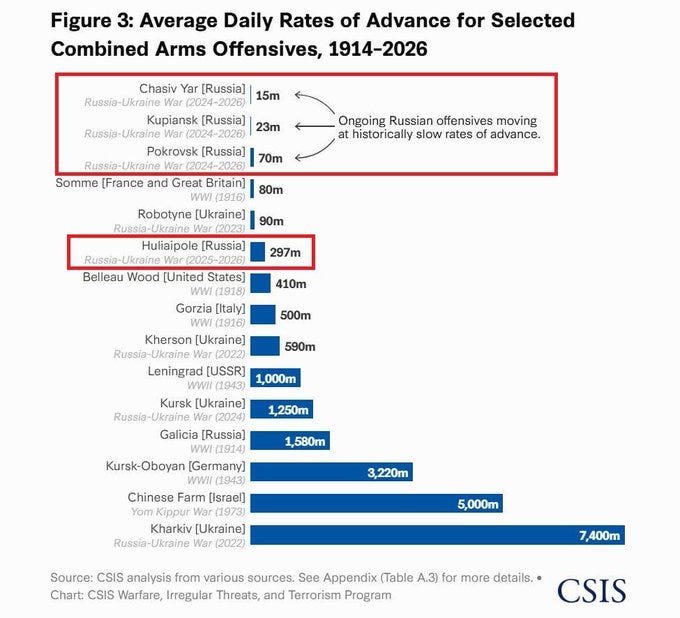
It is fascinating, though, how much urgency and desperation in the Western order such pitifully ‘slow advances’ are generating. If it’s really such a cock-up worthy of comparison to wars from hundreds of years ago, then why all this effort from the detractors? Russia’s failure and imminent loss should simply be self-evident to us.
Yet for some reason, we continue to get contrary signals. For instance, another exchange of bodies occurred yesterday:
Kremlin aide Vladimir Medinsky said that “within the framework of the Istanbul agreements, the bodies of 1,000 dead Ukrainian soldiers have been transferred to Ukraine”, adding that “bodies of 38 dead Russian soldiers have been transferred to Russia”.
Updated list:
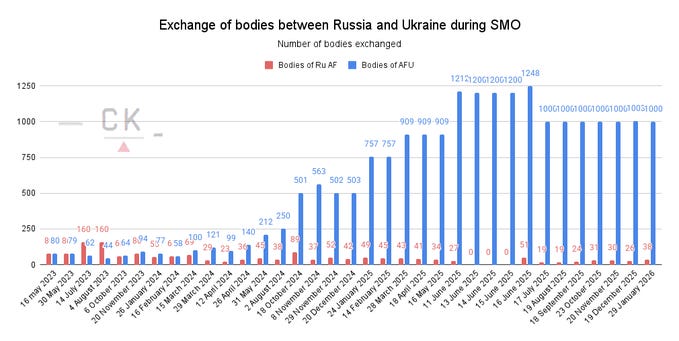
The Russian side appears in good spirits and confident. Here the head of Russian GRU Igor Kostyukov—who led the Abu Dhabi “tripartite” negotiations for the Russian side—cheerfully reveals that Russians are in a great mood, while Ukrainians are in a “sad mood”:
"The Ukrainians are in a sad mood. We're in a good mood": Igor Kostyukov, Chief of the Main Directorate of the General Staff, gave a succinct answer to Rossiya 1's question about the mood at the talks in Abu Dhabi.
He urged the media not to inquire about the negotiation process, as public comments negatively impact it.
Igor Kostyukov is heading the Russian delegation at the Ukraine talks in Abu Dhabi.
This does not seem like the demeanor representative of a side that’s been ground down to a historic and demoralizing crawl.
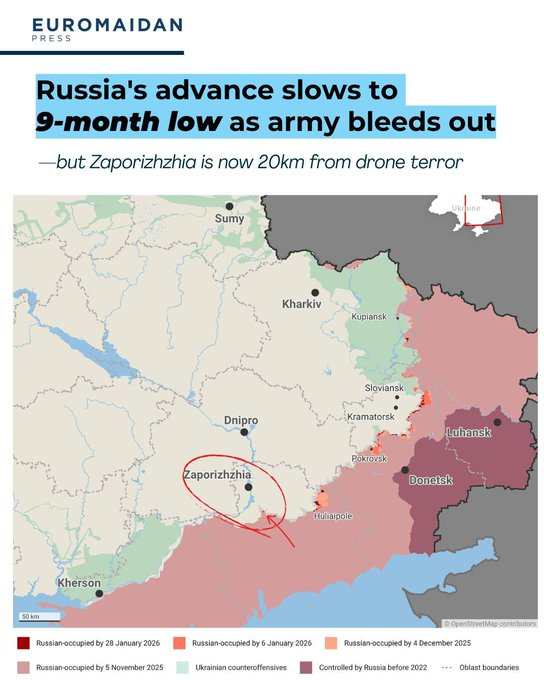
But let’s take a look at where Russia has been advancing and what clues it can give us about the nature of the current battlefield dynamic.
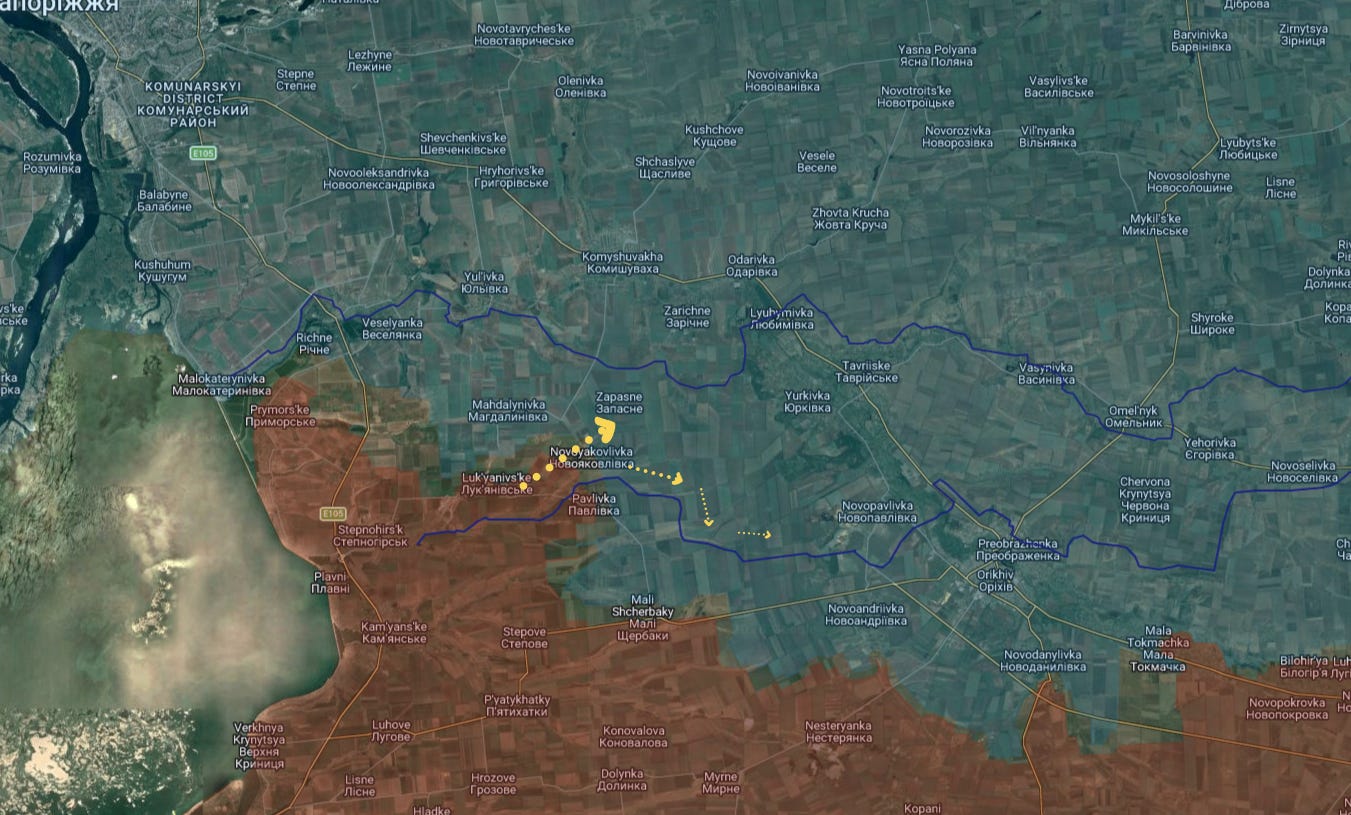
Most notably, Russia has continued advancing on both western and eastern sides of Zaporozhye. On the western side, Russian forces have made headway into a new northeasterly salient that appears to be following the first main Ukrainian line of defense there, skirting just around it:
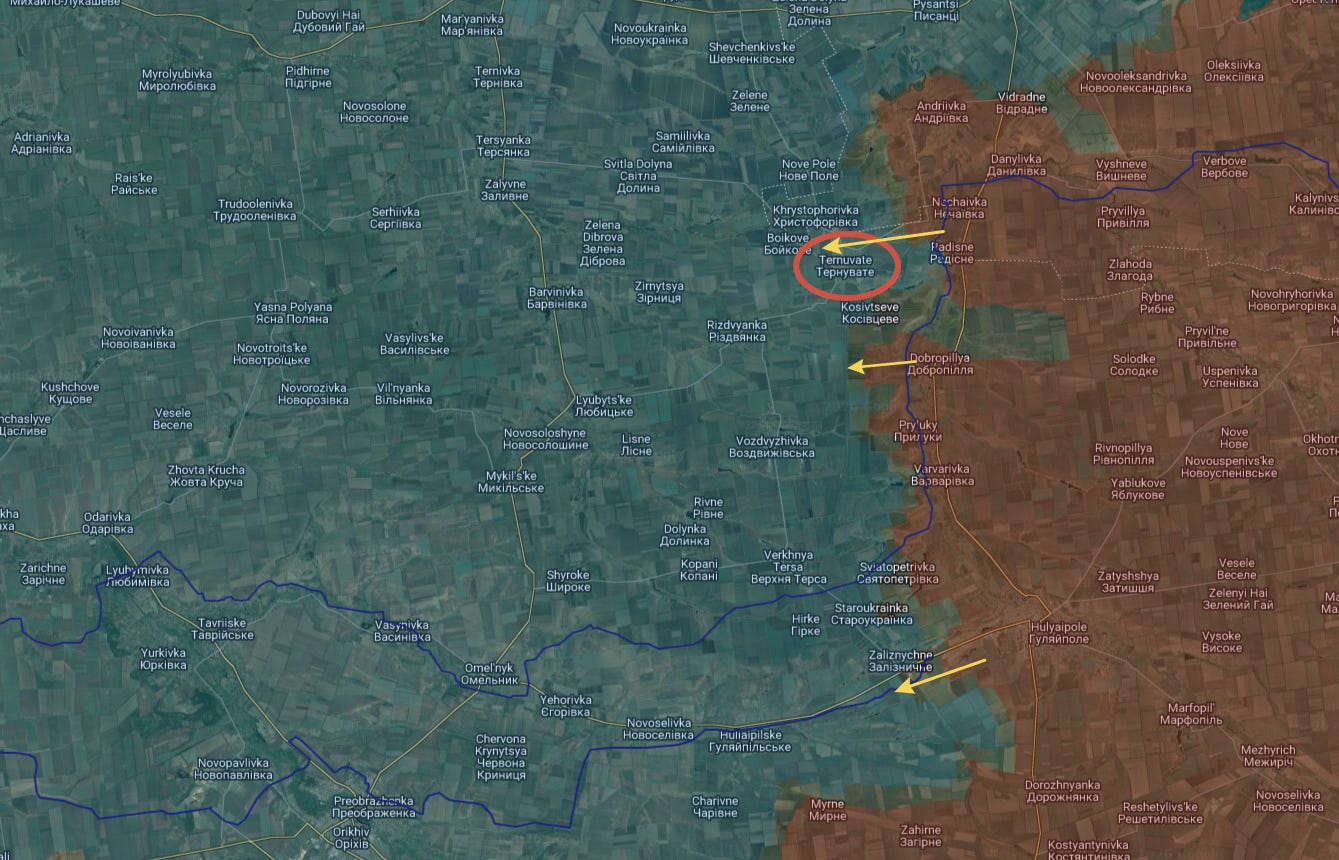
On the eastern side, Russian forces were said to have just entered and captured the settlement of Ternuvate, circled in red below:
Here is the video of the flag-planting ceremony by the 36th Motor Rifle Brigade of the 29th Guards Combined Arms Army of the now-legendary “Eastern Express”:
“UNITS OF THE “EAST” GROUP OF FORCES HAVE LIBERATED THE POPULATED POINT OF TERNOVATOE
🔸 Guardsmen of the 36th Motor Rifle Brigade of the 29th Army of the “East” Group of Forces have, with decisive and skillful actions during prolonged battles, liberated the major populated point of Ternovatoe in the Zaporizhia region.
🔸 As a result of active combat actions, soldiers from Transbaikalia have taken control of an important enemy defense area on the western bank of the Gaychur River, with a depth of up to 5 km and an area of more than 20 sq. km, and cleared over 580 buildings. The enemy’s losses amounted to up to 1 company of manpower and over 20 units of equipment (armored personnel carriers and pickup trucks) from the 33rd Separate Motor Rifle Brigade of the Ukrainian Armed Forces, over 45 hexacopters of the enemy type “Baba Yaga”, as well as 5 ground robotic complexes.
🔸 The occupation of this area has allowed to expand the bridgehead for further offensive on the western bank of the river Gaychur.
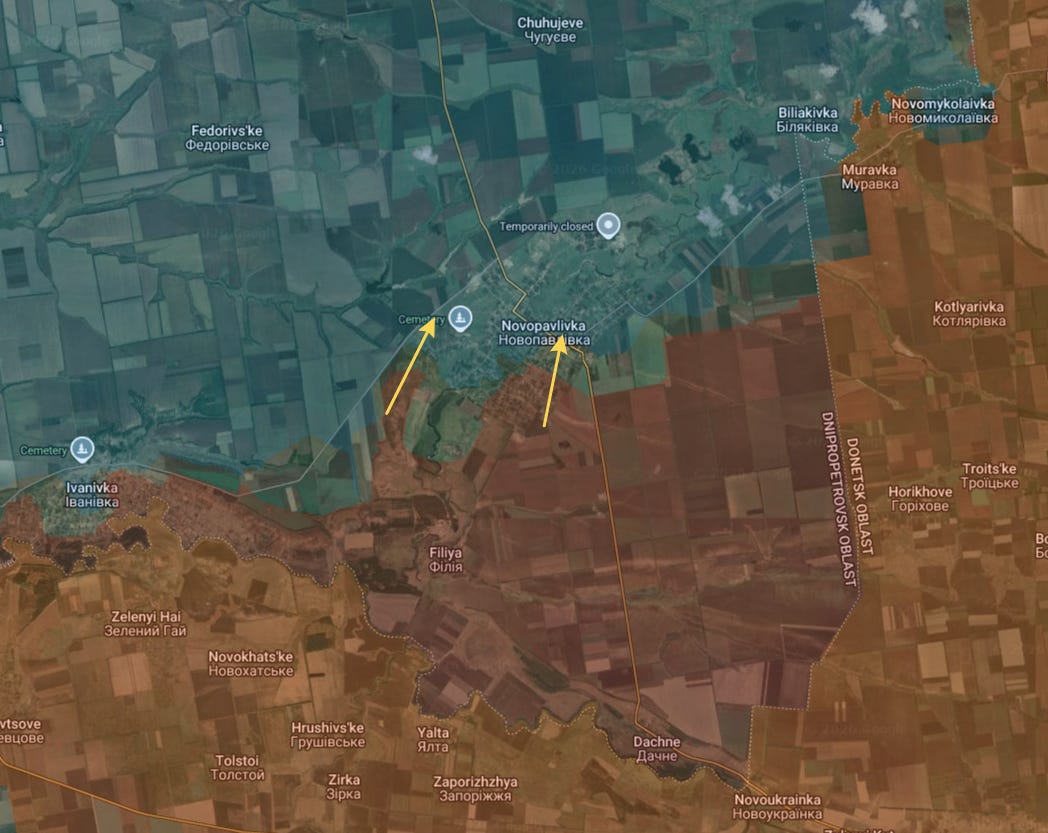
Just northeast of there, Russian forces have advanced further into Novopavlovka, entering the town center according to some reports:
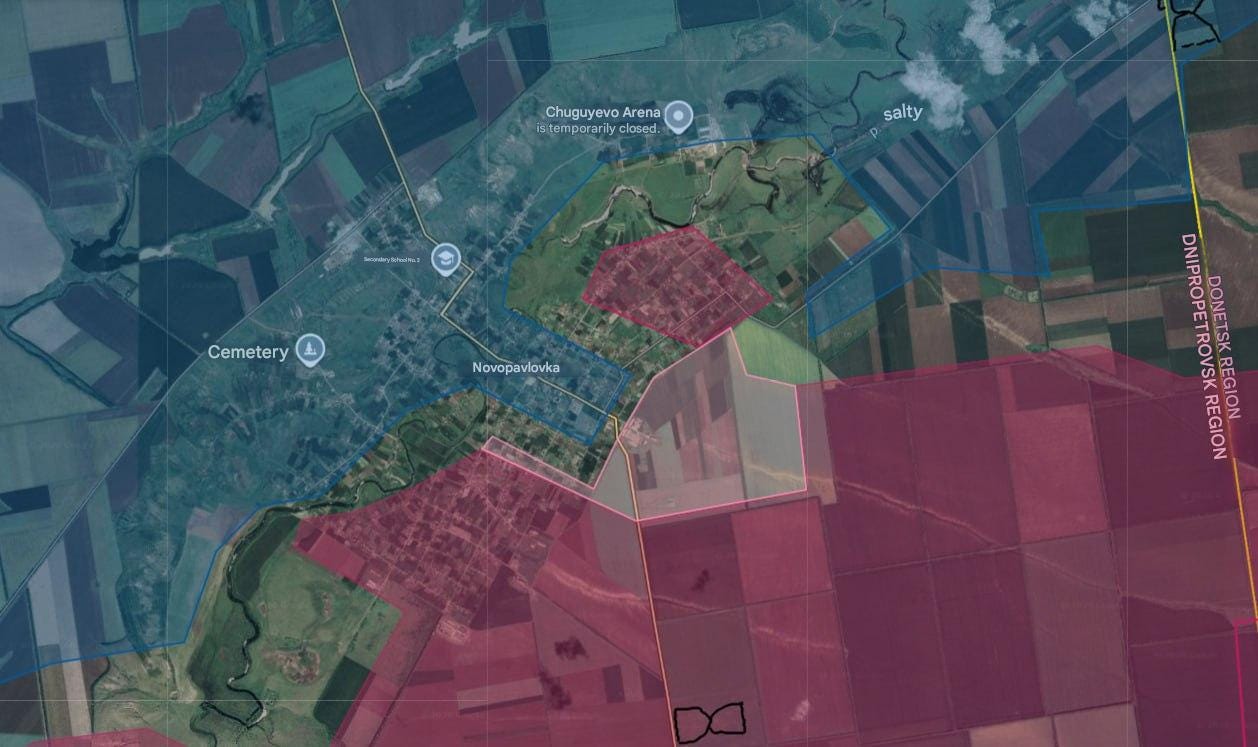
Other Russian maps have even more of Novopavlovka captured from the north:
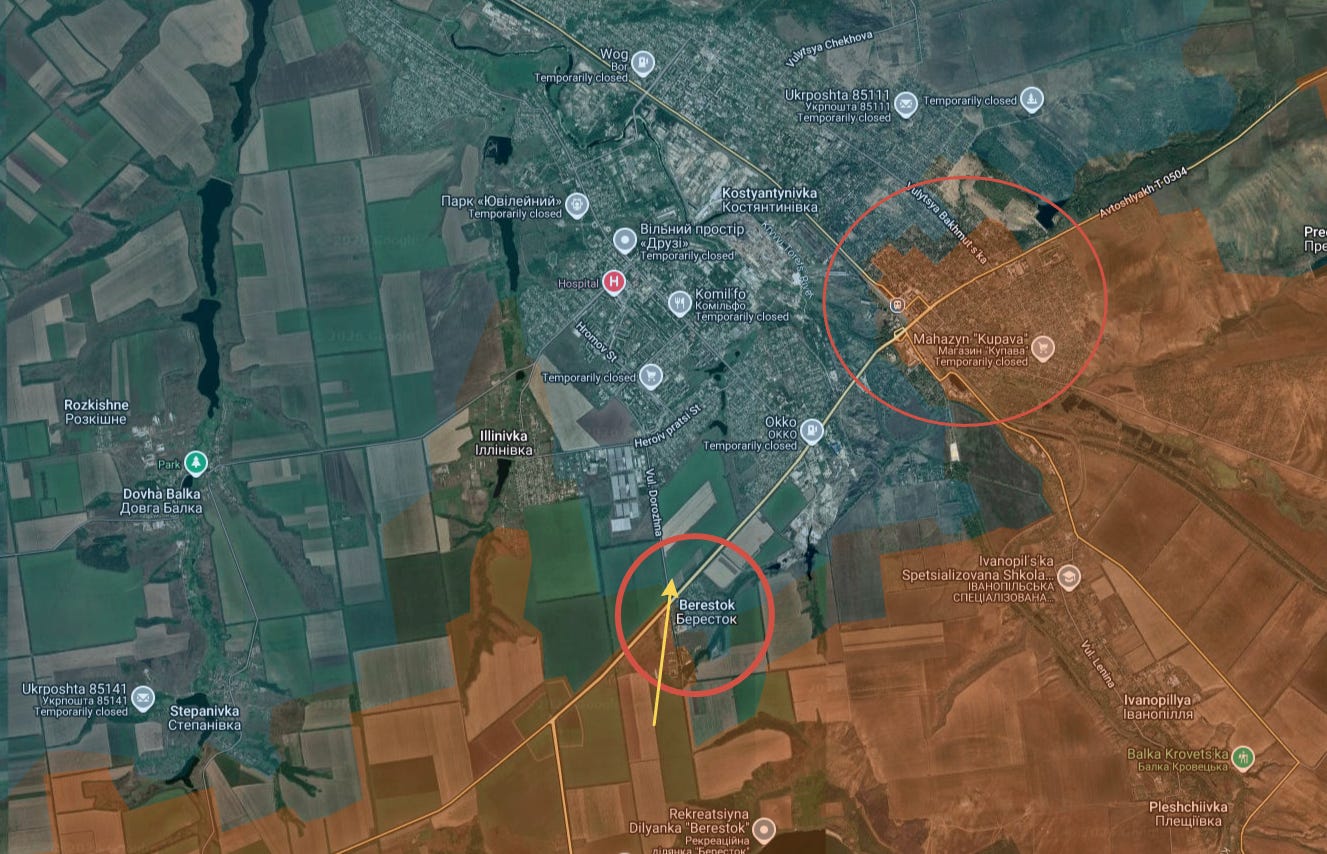
Further north on the Konstantinovka line, Russian forces captured either half or all of Berestok at the southern tip, depending on source:
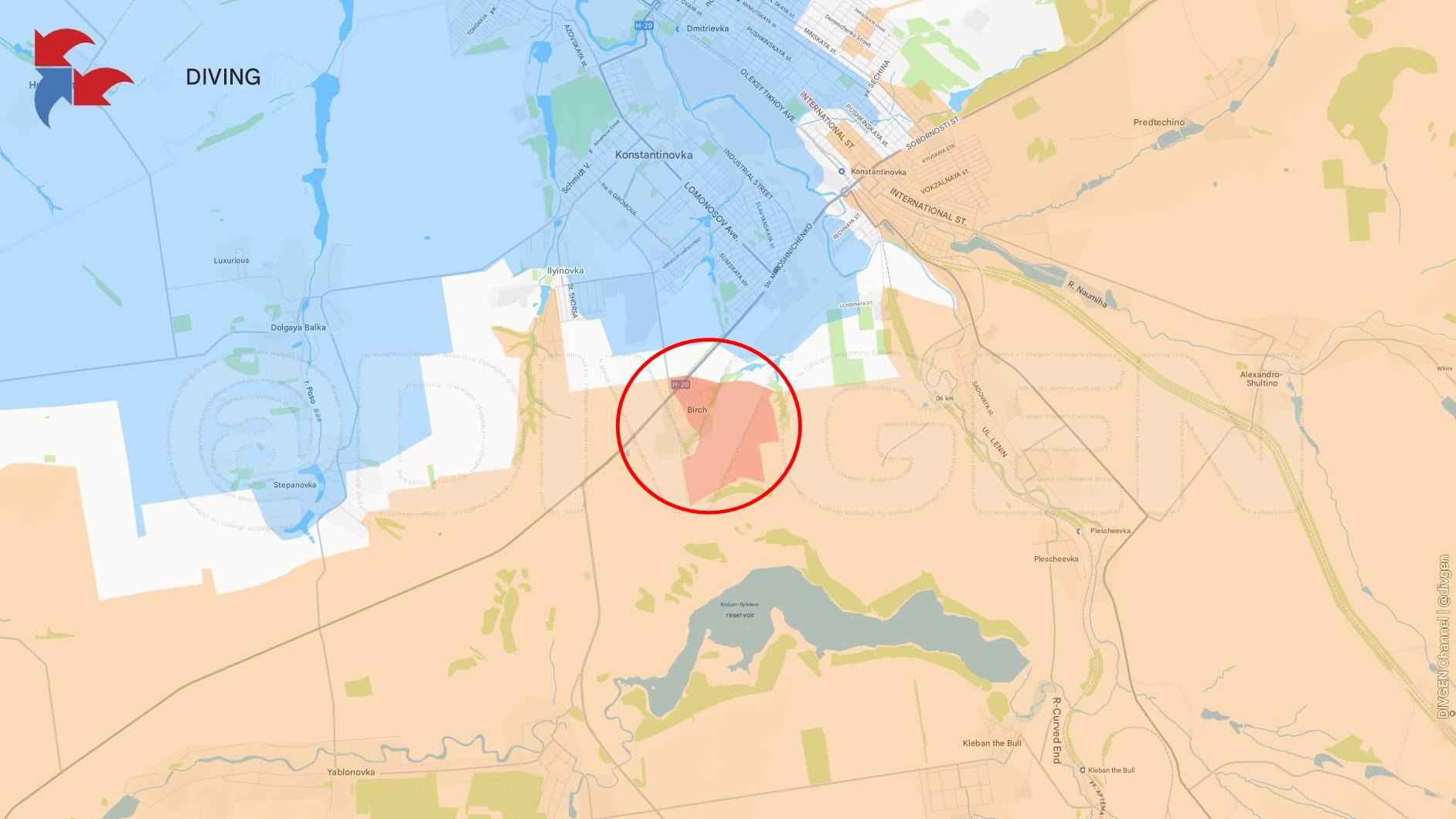
Note I’m using a few different map types this time because our favored cartographer Suriyak has reportedly gone on a brief vacation with only spotty updates to his map.
Besides Berestok though, it can be seen Russian forces have consolidated and advanced further into the city itself from the east:
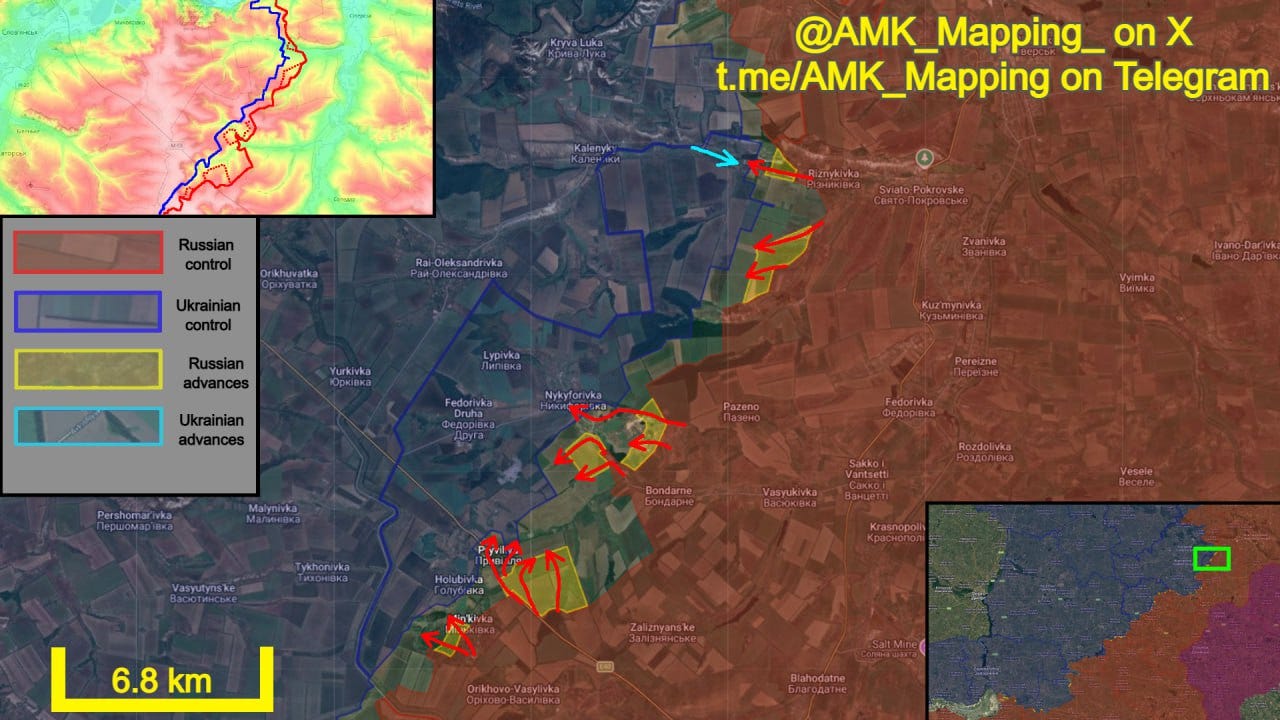
Switching to AMK’s maps, we see further north on the Seversk line that Russian forces are slowly inching westward along the broad front—the yellow areas are newly captured positions:
Seversk is circled for reference, and Slavyansk can be seen on the western edge:
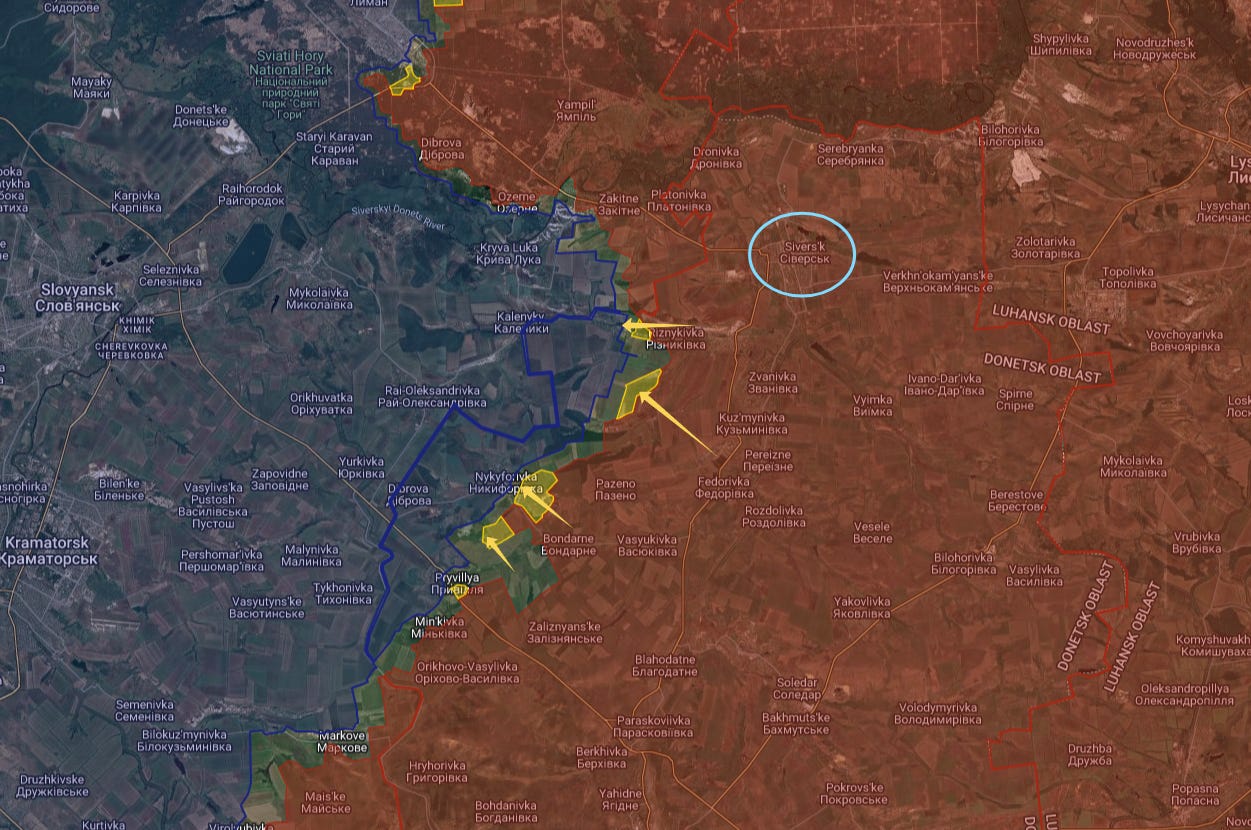
Essentially, they are all fairly minor advances. But what was most interesting is that Russia continues to pour forces over the northernmost border, to make incremental advances in northern Kharkov, Sumy, and most recently Chernigov regions.
The reasons this is revealing is because it runs counter to the Ukrainian claim that Russia has been ground down, is running out of men, and has slowed because of these issues, rather than simply reorganizing for new offensives or due to extreme and unfavorable weather, etc. If Russia was truly being ground down, it would not waste precious resources on totally fruitless and remote directions like these on the border, which have no major objectives easily achievable there. Russia would continue pouring everything into key focal fights where the most PR can be maximized, and Ukraine’s morale and reputation damaged, such as the mainstay cities of Konstantinovka and the like.
But the fact that Russia continues increasing the pressure in these remote hinterland zones means not only that Russia has manpower to spare, but that it is slowly shaping the battlefield for an extremely long-term strategy. And that would only be the case if Russia was quite happy with its available resources and manpower regeneration capabilities. It was even more telling, on this count, that Russia even opened up a totally new direction recently in Chernigov.
With that all said, Russian forces did advance slightly in some of these zones near Sumy and Kharkov, indicating that the wide-ranging ‘death by a thousand cuts’ strategy remains in force.
NYT’s latest underscores this more pessimistic take on Ukraine’s strangulation:
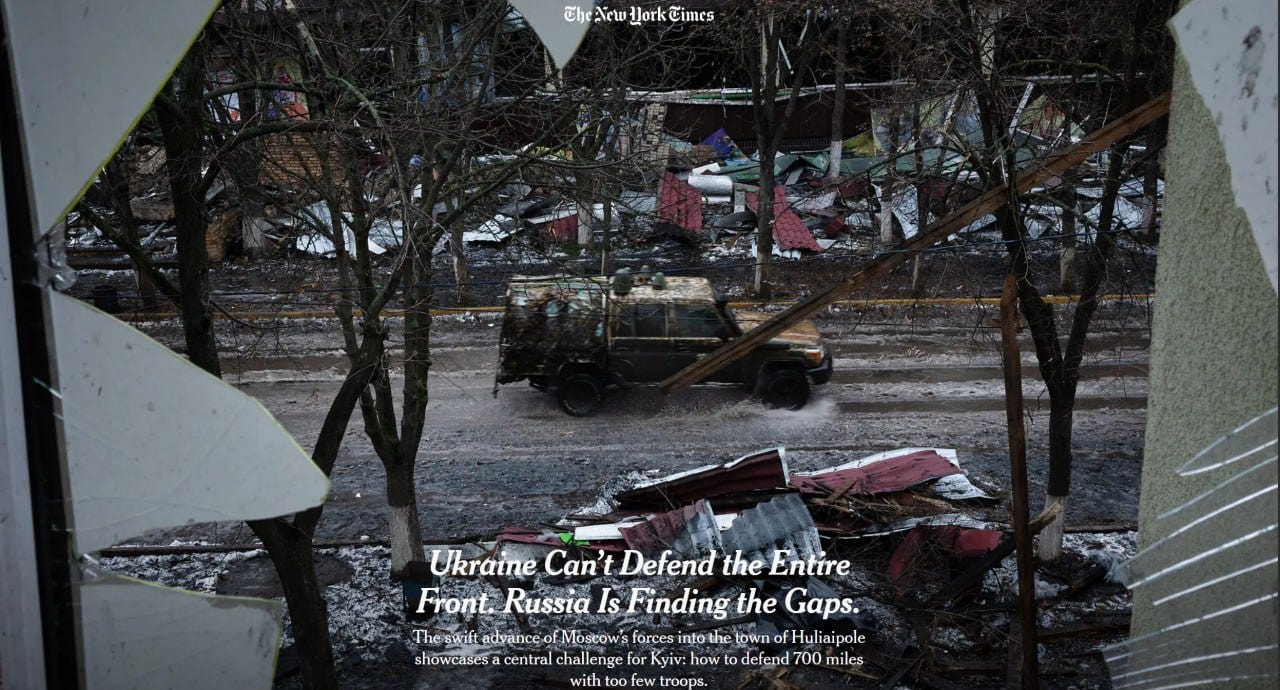
“It was a catastrophe,” said Capt. Dmytro Filatov, commander of the Ukrainian First Separate Assault Regiment, whose unit was rushed in to reinforce Huliaipole, in southeastern Ukraine.
The fall of the command post in late December…highlights the central challenge facing the Ukrainian Army after four years of grinding war. Stretched by Russian assaults across a 700-mile front line, Ukraine lacks enough troops to defend every sector equally, creating gaps where Moscow’s forces can advance more easily.
The article describes Ukraine’s current operative strategy:
But Ukrainian soldiers say the situation has forced them to wage war like firefighters — rushing to contain a flare-up in one sector, only to see another ignite elsewhere, then running back as the first combusts again. The goal is not to cling to every inch of territory, they say, but to hold enough to deny Russia battlefield momentum that would strengthen its hand in U.S.-brokered peace talks, which are continuing this weekend in the United Arab Emirates.
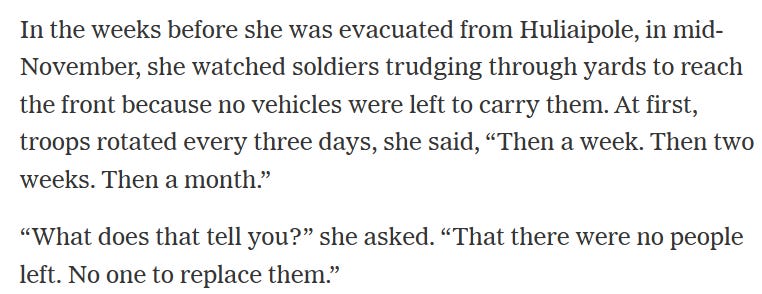
A Ukrainian battalion chief of staff explains their battalions are lucky to have 50 capable people in them—straight from the horse’s mouth:
“We’re constantly short on people,” Horol said, adding that Ukraine lacked troops to both repel infiltrations and launch counterattacks.
Vladyslav Bashchevanzhy, chief of staff of a drone battalion in the 260th, described the personnel issue bluntly.
“A battalion is supposed to have around 500 soldiers. In reality, we’re lucky if we have 100,” he said. “Out of those 100, perhaps only 50 are actually combat-ready — those not wounded or exhausted.”
But of course we’ve heard such stories since as far back as 2022 and 2023. It has not changed the fact that the war persists, and Ukraine continues to find the men necessary to keep Russian advances to a daily minimum, particularly by increasing its mobilization efforts and coercion levels, as we’ve seen recently.
This does not seem likely to change in the short term due to the current style of warfare: the ‘dispersed’ and defense-heavy strategy Ukraine employs keeps its losses low enough to be within relative replacement margins. Only when the AFU goes on offensive do their losses explode to stratospheric ranges, since troops are forced to go into the open where they can be far more easily eliminated en masse.
That said, another claimed report from an AFU soldier sheds further light:
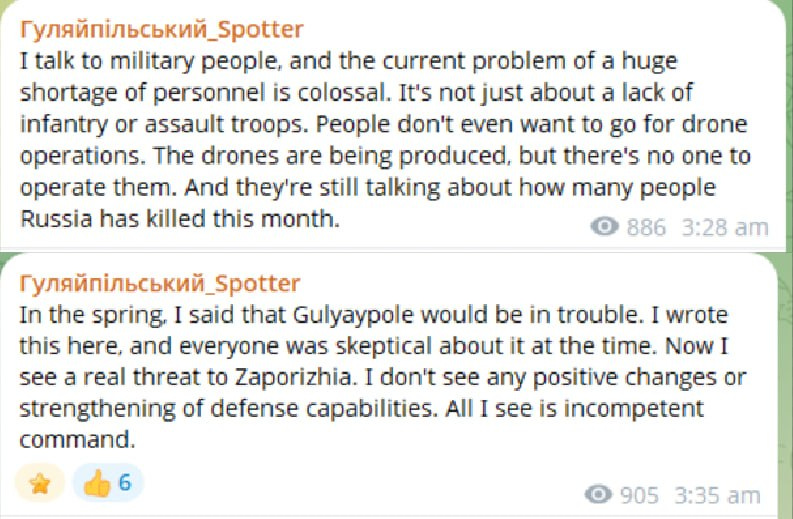
Ukrainian soldier from the 102nd Territorial Defence Brigade on the situation west of Hulyaipole.
It’s almost certain that Russian forces will pick up their offensive in the coming weeks when the weather begins to clear because there is no hard indication of any real limiting factor—like manpower issues—beyond recent weather woes or simple strategic reformulations on the front.
—
A couple last items:
The Russian “Yolka” drone interceptor has been spotted again on the front successfully taking down Ukrainian drones:
—
A Ukrainian F-16 pilot reveals that they loft to 3000-4000m to launch bombs but are almost always targeted by Russian Su-35s and S-400 systems at the apogee of their ‘loft-and-launch’ maneuver, before dropping down rapidly to try and escape the missiles:
This confirms that Russian assets are covering the frontline much more heavily than some people think, it’s just that long range missiles are more infallible than most assume, particularly when fired at maximum ranges. US Airforce studies have shown long range missiles have as high as 70%+ miss rates (fired at longer distances) as it becomes fairly simple for agile fighter jets to ‘bleed’ the missiles with evasive maneuvers.
—
On a related topic, a Danish report claimed that Denmark wants its F-16s back from Ukraine to defend Greenland:
Your support is invaluable. If you enjoyed the read, I would greatly appreciate if you subscribed to a monthly/yearly pledge to support my work, so that I may continue providing you with detailed, incisive reports like this one.
Alternatively, you can tip here: buymeacoffee.com/Simplicius